Zwift Hub vs Favero Assioma Duo: A Real-World Power Comparison
Comparing trainer and pedal power across the same indoor workout—and separating a useful agreement check from laboratory accuracy.
I swapped the usual Speedplay pedals on my indoor bike for Favero Assioma Duo power-meter pedals and recorded one structured workout from two power sources at the same time.
The aim was practical: find out whether the Assiomas and my Zwift Hub described the same ride closely enough to maintain consistent training data indoors and outdoors.
Test setup
The equipment was:
- an indoor bike on a Zwift Hub smart trainer;
- Favero Assioma Duo pedals;
- a Wahoo ELEMNT recording the pedals;
- Zwift running on an Apple TV 4K;
- the same heart-rate strap recorded in both activity files.
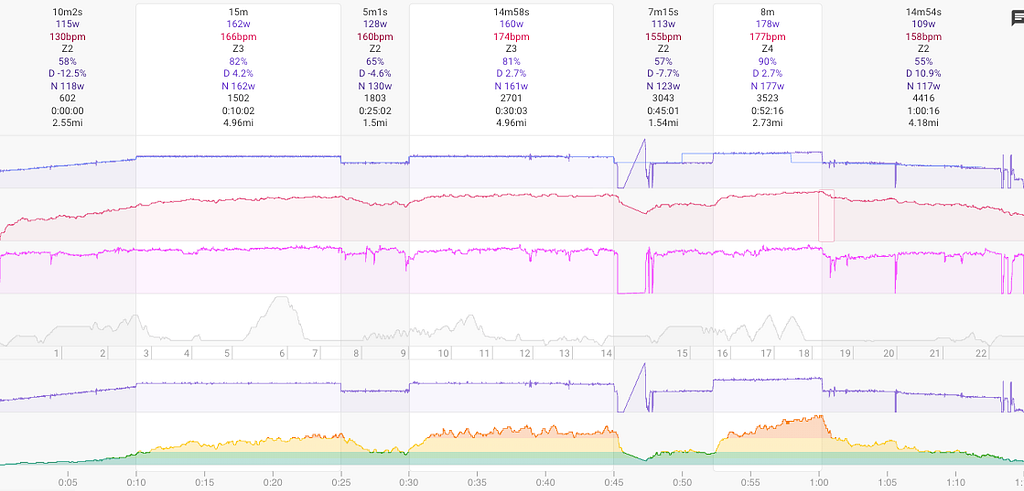
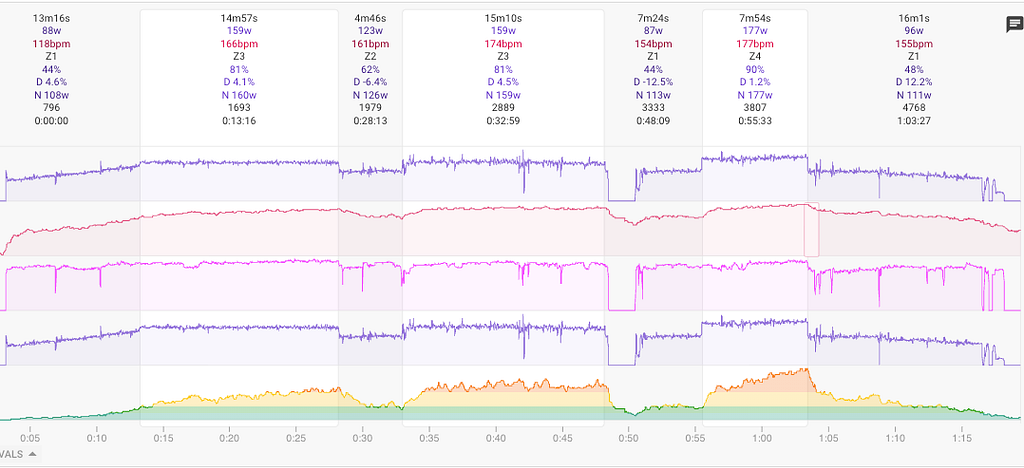
The workout contained a warm-up, two 15-minute tempo blocks, five minutes of recovery, an eight-minute sweet-spot block, four more minutes of recovery and a cooldown.
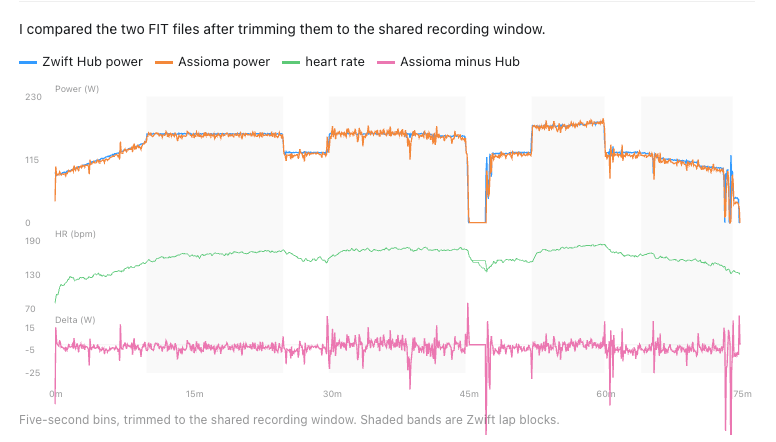
The two FIT files did not cover exactly the same period. The Wahoo recording began roughly three minutes earlier and ended about one minute later, so I compared only the overlapping window. The matching heart-rate traces provided a useful independent check that the files were aligned to the same physical effort.
Headline result
Across the shared portion of the ride:
| Metric | Zwift Hub | Assioma Duo | Difference |
|---|---|---|---|
| Average power | 137.6 W | 134.9 W | 2.7 W |
| Normalised power | 147.7 W | 145.9 W | 1.8 W |
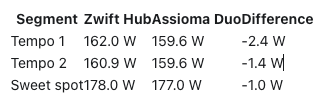
The pedals averaged about 1.9% lower than the trainer. The main work intervals were also close, with the sweet-spot block showing particularly strong agreement.
Why measurement location matters
The two devices do not measure at the same point. Pedals measure the rider’s input before the drivetrain, while a direct-drive trainer measures downstream of the chain and cassette. That can create a small systematic difference even when both devices are operating correctly.
In this session the Hub read slightly higher, which is the reverse of the simple drivetrain-loss expectation. That does not identify a fault by itself. Zero offset, trainer calibration, temperature, firmware, cadence, recording rate and each device’s stated accuracy can all influence a comparison this small.
Alignment check
The heart-rate files were almost identical:
- Zwift average: 161.46 bpm;
- Wahoo average: 161.30 bpm;
- maximum: 185 bpm in both files.
Heart rate is too slow-moving to prove sample-perfect alignment, but the matching trace supports the conclusion that the same workout sections were being compared.
What this test can—and cannot—show
This was an agreement test, not a calibration laboratory. One ride can reveal a large offset, dropout or obviously unstable sensor, but it cannot establish which device is absolutely correct to the watt.
A stronger follow-up would:
- perform the recommended zero offset or calibration first;
- control warm-up time and temperature;
- repeat steady intervals at several power levels and cadences;
- include short accelerations as well as sustained work;
- compare several sessions rather than one average;
- inspect whether the gap is constant or proportional to power.
Which source should anchor training?
For my training history, the Assioma pedals are the more useful reference—not because this test proved them more accurate, but because they follow the rider. The same measurement point works indoors, outdoors and across compatible bikes.
The Zwift Hub was impressively close. A roughly 2% difference would not change the interpretation of this workout, but using one consistent source for FTP, training zones and pacing avoids turning a small device offset into a false change in fitness.
The practical result: the pedal conversion showed no obvious measurement problem, and the two systems agreed well enough to make further controlled testing worthwhile.